Understanding Validated Dental 3D Printing Workflows:
A Complete Guide
The dental 3D printing industry has matured significantly in recent years. However, misconceptions about material safety and regulatory compliance still exist.
At the heart of producing biocompatible dental applications lies a concept that many consumers and even some manufacturers still misunderstand: a validated workflow.
What Is a Validated Workflow?
A dental 3D printing validated workflow is a complete, documented process for consistently producing safe, regulation-compliant results from start to finish. It takes far more than simply selecting a biocompatible resin and pressing “print.” The reality is more nuanced and critically important for patient safety.
“The most common misconception regarding biocompatible resin is that many users assume that a material with proven biocompatibility or a classification as a Class IIa medical device can be used without further consideration for a wide variety of clinical applications,” said Stefan Schüller, Senior Application Expert at detax GmbH, “In fact, every medical device can only be used within the scope of its specific intended medical purpose.”
3D Printing Resins: The Biocompatibility Myth
Resins are basically liquid photopolymers. Regardless of their intended final use, they are inherently hazardous materials. Their Material Safety Data Sheets (MSDS) clearly identify risks to human health and the environment in their uncured state. The transformation from hazardous liquid to a safe dental device doesn’t happen automatically; it requires precise control over every step of the 3D printing process
“Especially for medical devices, biocompatibility is a requirement,” said Luisa Schneider, Product and Material Partner Manager at Rapid Shape, “materials need to be processed in a way that they meet the standards given by the manufacturer. If you treat the material differently during printing, it will no longer meet the manufacturer’s requirements. Curing and washing can affect the material properties (mechanical and biocompatibility), too, and therefore validating the whole workflow is crucial.”
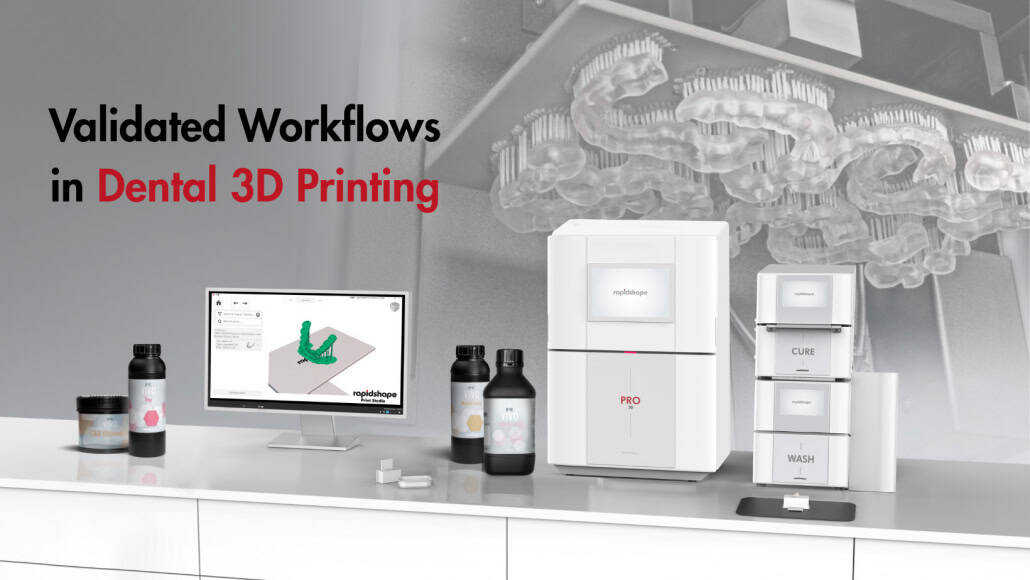
This distinction matters: it’s not the material alone that qualifies a dental device for use, but the entire validated workflow, that evidently includes the 3D printer chosen and, as importantly, the post-processing equipment, too.
The Pillars of Dental 3D Printing Workflows Validation
A properly validated dental 3D printing workflow must document and control five critical elements:
1. Curing Time and Parameters
The exposure time during printing directly affects the degree of polymer conversion. Insufficient curing leaves reactive monomers that can leach into the patient’s mouth, while over-curing can compromise the application’s mechanical properties.
3D Printer manufacturers need to work in tandem with resin manufacturers to ensure the parameters used for their workflows satisfy both criteria. The resin validation process can be lengthy as both companies need to rigorously test the results until the perfect settings are achieved that results in durable, biocompatible applications that can be replicated print after print.
2. Shrinkage Calibration
Photopolymers shrink during curing, and this shrinkage must be precisely characterized and compensated for to ensure the accuracy required for the applications. In dental applications where fit and function are paramount, dimensional accuracy isn’t negotiable. A crown that’s off by even fractions of a millimeter can cause occlusion problems or simply fail to seat properly.
The technology behind the 3D printer being used (DLP vs LCD), light intensity consistency, UV wavelength, all play an important role in refining the right parameters to avoid said shrinkage. The post-processing UV oven chosen is also crucial in guaranteeing the perfect clinical fit.
3. Cleaning Protocol Definition
The selection of cleaning solvents, immersion time, and agitation methods must be specified and validated. Residual uncured resin poses significant biocompatibility risks. While some companies work with resin manufacturers to validate their printers and UV-curing ovens, many still do not include the cleaning one as part of their validation workflow.
4. Post-Curing Requirements
Post-curing conditions (including time, temperature, light spectrum, and atmospheric conditions such as presence of oxygen or nitrogen environments) must be precisely defined. This final curing step ensures maximum polymer conversion, which guarantees patient safety, and optimal material properties, for long-lasting applications.
“Post-processing is a central part of the validated workflow because it directly determines the safety and functionality of the end product,” said Stefan Schüller, Senior Application Expert at detax GmbH. “As a manufacturer, we at Detax not only deliver the medical device (resin), but also a fully validated workflow. If cleaning and post-curing are not carried out according to this workflow, it can lead to incomplete polymerization, insufficient mechanical properties, or chemical residues. The consequences range from patient irritation to poor mechanical properties, which can have a direct impact on regulatory compliance. It is therefore essential that users consistently adhere to the validated workflow specified by Detax (or the resin manufacturer of their choice)”
5. Post-Finishing Instructions
Any additional steps such as support removal, surface treatment, or sterilization methods must be documented as part of the validated workflow.
Regulatory Framework and Dental 3D Printing Validated Workflow Standards
Both the FDA in the United States and the European Union’s Medical Device Regulation (MDR) have established stringent standards for 3D-printed dental devices. These regulatory frameworks recognize that dental device safety cannot be guaranteed by material selection alone.
“Every human activity has potential for failure. So, a validated workflow ensures that the essential parts of processing a resin are done in a regulated manner consistently,” said Luisa Schneider, Product and Material Partner Manager at Rapid Shape, “With us, the printing process is defined, how long and with which settings a resin is cured and washed is preset. This traceability and reproducibility are essential for regulatory approval and, more importantly, for patient safety.”
When choosing a dental 3D printer that offers validated workflows, users are advised to also consider product availability in different markets since these strict regulations can limit options but ensure safe-to-use and biocompatible results.
“With more and more biocompatible applications becoming available, we are seeing a lot of emphasis on FDA approval and patient safety,” said Kelly Fincher, Digital Workflow Specialist at Rapid Shape. “I think validation is where we are seeing new standards that are requiring manufacturers to be held accountable for not only their reliability but also their safety. I think it’s possible that much like the Identceram certificates we have for restorations, we could see a similar system being implemented for 3D printing in the future.”
The Value Proposition for Dental Clinics and Laboratories
For dental laboratories, dental device manufacturers, and dental clinics, a validated dental 3D printing workflow offers several critical advantages:
- Regulatory Compliance and Risk Mitigation: Pre-validated workflows significantly reduce the time and cost of bringing final applications to the end users, as much of the validation work has been completed by material and equipment manufacturers working in partnership, therefore, users enjoy zero guesswork and full peace of mind since the documented processes reduce liability exposure and provide clear quality assurance protocols.
- Consistency: Validated workflows ensure that every dental application printed is identical to the first in terms of quality and safety (as long as the user sticks to the validated workflows and manufacturer’s instructions for use), maintaining quality across production runs and operator changes.
- Efficiency: Rather than developing and validating processes internally, dental clinics and laboratories can implement proven workflows immediately. Reducing costly manual labor and allowing for complete focus on what matters the most.
“I’m seeing people take printing more seriously. Earlier adopters would often seek the cheapest solution to get into 3D printing,” said Kelly Fincher, Digital Workflow Specialist at Rapid Shape. “Today, as printing and resins have evolved, it has become such an integral part of the digital workflow that people are looking for validated, accurate printers that can keep up with production demands.”
The Future of Validated Dental 3D Printing Workflows
As additive manufacturing continues to expand into new dental applications, the importance of validated workflows will only increase. The collaboration between resin manufacturers, equipment producers, dental clinics and laboratories in developing and refining these workflows represents a maturation of the industry.
“Under the MDR, dental practices and labs have to make their processes more transparent and use clearly validated workflows,” said Stefan Schüller, Senior Application Expert at detax GmbH. “This means that validation is less of an option and more of a necessity for quality management. This means that standardized, end-to-end workflows specified by the manufacturer will become increasingly important to ensure that everything is secure, efficient, and compliant.”
For any dentist or dental technician considering 3D printing applications, understanding and implementing validated 3D printing workflows isn’t just a regulatory checkbox. It’s the foundation of responsible manufacturing and patient safety.
Thinking about implementing 3D printing? “What are you waiting for? Your customers will push you to adopt it, or you will limit yourself moving forward,” said Kelly Fincher, Digital Workflow Specialist at Rapid Shape. “The new wave of dentists coming up is fully embracing technology, and while I think there will always be a time and place for an impression, a vast majority of dentistry will move to digital. I don’t want to see analog labs become irrelevant; I want to see them transform. Validations are something that will progress dentistry to be better. The resins of the past years are not the same today. Partnering with companies that value validated workflows is the future of 3D printing.”
For more information about validated dental 3D printing workflows, consult with material manufacturers and equipment providers who can provide documentation of their validated processes and regulatory compliance support.

Kelly Fincher
Digital Workflow Specialist, Lab
Rapid Shape GmbH

Luisa Schneider
Productmanager
Rapid Shape GmbH